Expand your fleet management library with free J. J. Keller resources. Over 200 years of collective experience and education — that's the J. J. Keller difference.
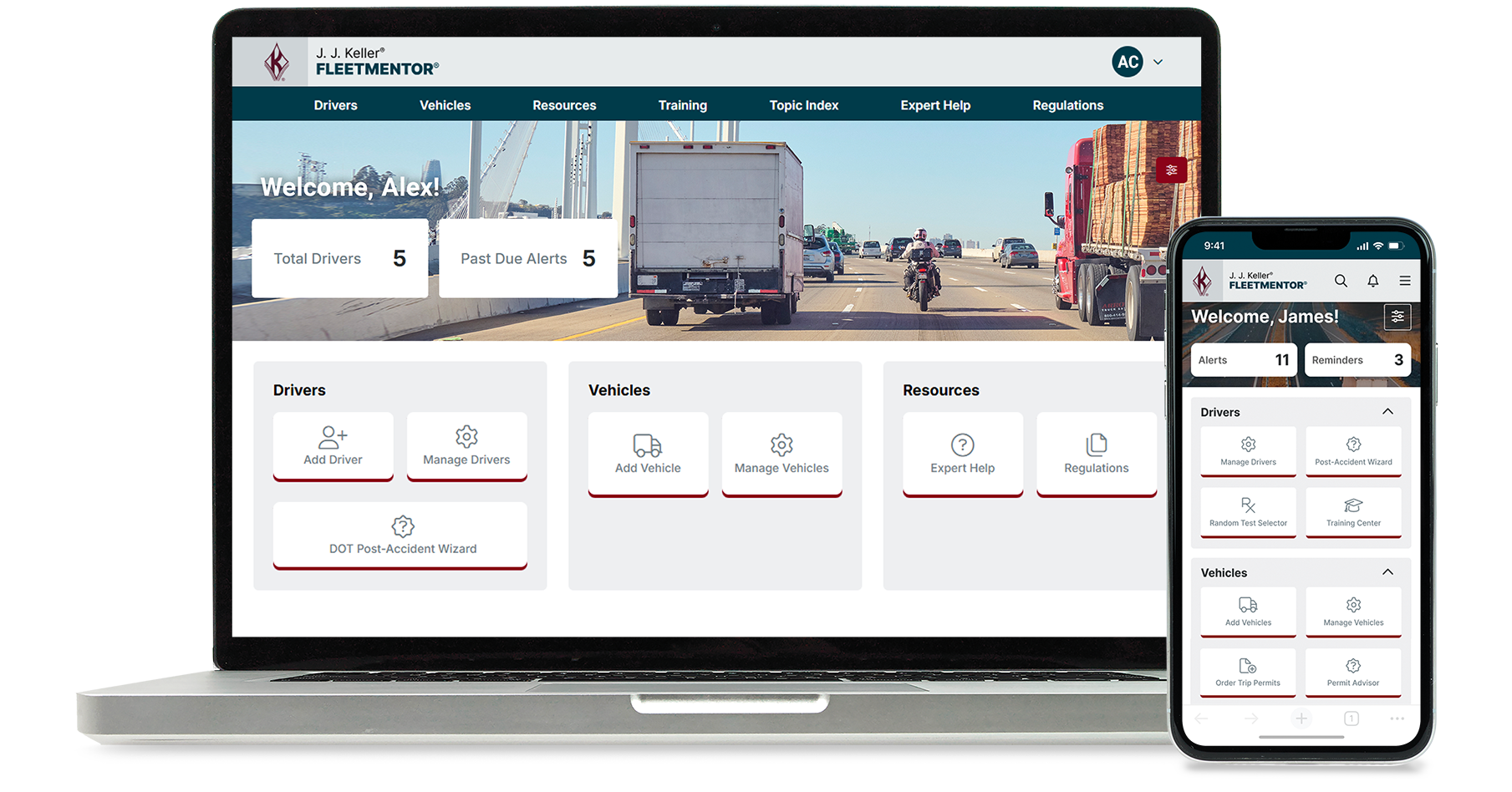
Welcome to the FleetMentor® System
Take control of driver compliance, vehicle maintenance and fleet operations with the system that simplifies it all.
Take a no-obligation 30-day FREE TRIAL today!
Fleet Management Success, Right at Your Fingertips
Manage company vehicles and drivers faster, more accurately, and with fewer headaches.
The J. J. Keller® FleetMentor® System is the easy way to manage your fleet, comply with FMCSA requirements, and organize recordkeeping. It combines trusted compliance expertise, practical guidance, and AI-enhanced technology to help transportation professionals make more informed decisions and operate with confidence.
Start Today with FREE Access!
Join the thousands of safety professionals who rely on FleetMentor to make more informed decisions, reduce expenses, ensure driver compliance and improve vehicle performance.
Take a no-obligation 30-day FREE TRIAL today!
What FleetMentor Users Are Saying
"FleetMentor is a great tool for the transportation professional and well worth the investment - in time saved doing your job and the vast array of resources available through its many individual offerings."
Dan Oswald
DOT Compliance Officer
"I have been very pleased with my subscription to FleetMentor. It has made maintaining driver files a breeze. The Roadside Inspection tool is great and breaks down the categories effectively so that you can find your deficient areas. A huge benefit of FleetMentor is the ability to import spreadsheets - it speeds up your process and allows you to be more effective."
Mitch Henderson
Fleet Safety Manager
“I’m a two year user with over 800 drivers in five geographic areas. I have five users from my company on FleetMentor that are my DQ file custodians. FleetMentor gives me the ability to monitor everyone’s dates and data. The training is great for the outline and slides and gives us a good starting point for educating our drivers. The ability to talk with other trucking guys through the Discussion Boards is extremely useful as well. Unless you are one of the ‘big boys’ with their own proprietary DQ software, FleetMentor is a great bang for the buck. J. J. Keller has been very responsive with changes that I recommended early on when the product first came out. It works really well for me, that’s all I can say.”
Ken Stambaugh
Fleet Safety Director
"I really like the ability to look up the HazMat information in FleetMentor. When our manager ask me if we can haul this or that, I just click on the chemical name and print him a complete description with all the information that we need to make the decision. It is extremely handy and takes a fraction of the time that it did for me to look it up in the book and transfer the information to dispatch."
Bill Bracken
Fleet Safety Manager
“FleetMentor has been extremely helpful, useful and easy to use!”
Sue Galloway
Controller
- Dan Oswald Testimonial 1
- Mitch Henderson Testimonial 1
- Ken Stambaugh Testimonial 1
- Bill Bracken Testimonial 1
- Sue Galloway Testimonial 1
Fleet Management Resources
6 Steps to Maintaining a Compliant DOT Random Testing Program
Random drug and alcohol testing is often seen as the cornerstone of DOT testing. Here are six steps to maintaining a random testing program.
DOT Compliance Academy: 3 Steps to Safer, Smarter Operations
Led by J. J. Keller's trusted regulatory experts, this on-demand workshop walks you through the essential components of a strong compliance program.
CDL vs. Non-CDL DQ Files
With a simple side-by-side comparison, this guide helps quickly identify what's required to be in the driver qualification files for both CDL and non-CDL drivers.
The J. J. Keller Purpose
We protect people and the businesses they run.®
We help ensure safe, respectful workplaces, job sites and highways. So employees thrive. So they return home each day to the families who love them. We empower businesses to excel by removing risk and giving them confidence that they are meeting complex regulations. We lead by example in our own communities by embracing those most in need and the programs that sustain them.
FAQs
FleetMentor serves companies with regulated commercial trucks as well as light-duty business vehicle fleets across a variety of industries, including transportation, industrial, construction, utility, healthcare and education.
Section 391.51 of the Federal Motor Carrier Safety Regulations details what a driver qualification file must contain. The file must include:
- Application for employment (391.21);
- Initial 3-year motor vehicle record (MVR) from state(s) where driver was licensed (391.23(a)(1));
- Road test form and certificate (391.31(g)), or a commercial driver’s license (CDL) or current road test certificate accepted in lieu of road test (391.33);
- Medical exam certificate (original or a copy) (391.43(g)), an MVR showing CDL driver’s medical certification status and self-certification information (391.23(m)), or the original of the written statement providing that the motor carrier determined the driver is not required by 391.44(d) to complete a road test pursuant to 391.44(d)(3)(ii)(A) and the original, or a copy, of the driver’s certification required by 391.44(d)(3)(i);
- Documentation that the medical examiner is listed on the National Registry (391.23(m)(1)) (For CDL drivers, the verification is not required on and after June 23,2025, for drivers licensed by states receiving direct updates from the National Registry of Certified Medical Examiners (NRCME));
- Any documentation of a medical variance;
- Annual driving record (MVR) (391.25(a)); and
- Note relating to annual review of a driver’s safety record and violations (391.25(c)(2)).
The driver’s qualification (DQ) file is often thought to go hand-in-hand with the commercial driver’s license (CDL). This has created confusion for many carriers. For interstate drivers, the need for a DQ file is based on the size and type of vehicle being driven. The applicable definition of commercial motor vehicle includes both CDL and non-CDL drivers alike. Intrastate drivers would need to look at state-specific regulations to determine applicability.
Drivers operating the following vehicles in interstate commerce need to have a completed DQ file:
- Vehicles with a gross vehicle weight (GVW) or gross vehicle weight rating (GVWR), or gross combination weight (GCW) or gross combination weight rating (GCWR) of 10,001 pounds or more; or
- Vehicles designed to transport more than 8 people (including the driver) for compensation, or more than 15 people (including the driver) not for compensation; or
- Vehicles transporting hazardous materials that require the vehicle to be placarded.
The criterion in this definition that causes most confusion is the vehicle weight. The general weight criterion for which a CDL is needed is 26,001 pounds. The weight criterion for which a DQ file is needed is 10,001 pounds. So, interstate drivers of vehicles between 10,001 and 26,001 pounds (not hauling hazmat) need to have a DQ file but do not generally need to have a CDL.
For intrastate drivers, it depends on what the state has adopted for the weight criterion. A number of states use the same 10,001 pound criterion as is found in the Federal Motor Carrier Safety Regulations. Other states have increased the weight limit to anywhere from 12,000 pounds up to 26,001 pounds (which does coincide with the CDL requirements). A few states also have grandfather clauses or other exemptions that may except certain drivers from certain portions of the DQ file, such as medical cards.
The CDL regulations apply to anyone driving a commercial motor vehicle as defined in 383.5 on a roadway that is open to public travel.
This means that mechanics, yard jockeys, supervisors, occasional drivers, or others operating CMVs on public roadways are required to have a CDL. Sometimes there is confusion as to who falls under Part 383, espcecially when the driver does not operate under an actual motor carrier or motorcoach operation. The following entities are not exempt:
- School bus, church bus, and van pool drivers operating vehicles designed to transport 16 or more passengers. This includes the operation of a vehicle from manufacturer to the distributor.
- State, county, and municipal employees, unless driving exempt emergency vehicles.
- Motorized cranes and vehicles used to pump cement at construction sites, because these vehicles are designed for highway use.
- Student drivers attending a driver training school.
- Civilian operators of vehicles operating within a military facility that is open to public travel.
- Other vehicles that the state has decided requires a CDL.
Yes. Since the Federal Motor Carrier Safety Regulations apply to interstate commerce, crossing a state line does not affect the use of the short-haul exceptions in 395.1(e). Keep in mind that if you are operating in intrastate commerce and following the state-specific hours-of-service regulations, crossing the state line places you under federal regulations.
When a driver has a confirmed positive, or engages in other prohibited drug or alcohol behavior, the driver must be removed from a safety-sensitive function per 382.501. The employer must present the driver with a list of Substance Abuse Professionals (SAPs) per 40.287. The list must be given without a fee, and the carrier cannot force an employee to seek the evaluation. The list, also, must be made available to the driver (or driver applicant) whether or not the carrier retains the driver in their employ. (Retention of the driver would be based on company policy.)
The violation is reported to the CDL Drug and Alcohol Clearinghouse to appear on the driver’s record. The driver will be placed in a prohibited status until the Clearinghouse receives reports of a completed SAP program and negative return-to-duty test. This prohibited status also results in a downgraded CDL or CLP until it switches back to not prohibited.
In order to resume a safety-sensitive function and reclaim the CDL or CLP, the driver must complete the Return-to-Duty Process of Subpart O of Part 40. The driver cannot perform a safety-sensitive function again until all the necessary steps are completed:
- The driver must seek a face-to-face* evaluation from a SAP. (Payment of the evaluation is based on management-labor agreements and healthcare benefits and is not required of the employer under the FMCSRs.)
- The SAP will refer the driver to an appropriate treatment and education program.
- The driver must complete the required treatment and education and return to the SAP for another face-to-face* evaluation.
- If the SAP is satisfied that the driver is able to return to driving, the SAP will report the completed steps to the Drug and Alcohol Clearinghouse, and issue a report on their findings to the Designated Employer Representative.
- This report will list any continuing treatment and education, if required, and the number of DOT follow-up drug and/or alcohol tests required in a given time frame. The driver will be required to have a minimum of six unannounced follow-up tests in the first 12 months following the employee’s return to a safety-sensitive function. The SAP may require follow-up testing for up to five years.
- The driver now can go, and not prior to this point, for a return-to-duty drug and/or alcohol test. The employer must wait for the go ahead from the SAP before sending the driver in for the return-to-duty test. A negative result must be received and reported to the Clearinghouse by the employer before the driver can return to a safety-sensitive function.
*At the SAP’s discretion, the initial and follow-up evaluations may be performed face-to-face in-person or remotely. If a SAP is not prohibited from using technology within the parameters of the SAP’s state-issued license or other credential(s), a remote evaluation must be must be conducted in accordance with DOT criteria.
After the driver returns to a safety-sensitive function, the employer must send the driver for the required number of unannounced follow-ups making sure that they do not have any discernible pattern.
Clearinghouse recordkeeping
The driver must have a Clearinghouse account in order to designate the SAP in the database. Once designated, the SAP indicates that the driver has completed the evaluations and rehabilitation and treatment.
The employer under whose program:
- The return-to-duty test is performed must report the negative result to the Clearinghouse. The driver’s status no longer shows as prohibited once received.
- The follow-up program is completed must report that the last follow-up test was performed.
The employer’s submissions do not require that the driver provide consent.
Driver information is removed when the above steps are reported to the Clearinghouse AND five years pass since the original violation.
Employer recordkeeping
All records relating to a DOT-drug and alcohol violation must be retained for five years per 382.401. If the driver leaves the motor carrier’s employment prior to the completion of the very last follow-up test, this information must be supplied to the prospective employer per 40.25, and the next employer(s) must pick up where the process left off.
Essentially, Part 382 applies to those required to hold CDLs (or the Mexican or Canadian equivalent), and their employers. This means that, unlike most other safety regulations, FMCSA testing applies to both intrastate and interstate CMV drivers. So if a truck is large enough to require a CDL, the driver is subject to drug and alcohol testing even if driven a few miles per week and never crosses state lines. This could include a mechanic, dispatcher, warehouse worker, or any other occasional or fill-in driver.
Exemptions exist for those who are exempt from the CDL regulations, including certain farmers, military personnel, firefighters, and those operating CMVs on private property with controlled access.
No, there aren’t any specific regulations dealing with accident investigation; it is in your company’s best interest to investigate or hire someone to perform an accident investigation. There are three key steps to performing a complete accident investigation:
- Data gathering;
- Analysis; and
- Response (reports).
Any records relating to an accident must be made available to an authorized agent or special agent of the Federal Motor Carrier Safety Administration (FMCSA) upon request or as part of any inquiry. According to 390.15(a), a motor carrier must give all reasonable assistance in the investigation of an accident by FMCSA, including providing a full, true, and correct answer to any question of the inquiry.
No. However, the report must cover at least the following parts and accessories:
- Service brakes including trailer brake connections;
- Parking (hand) brake;
- Steering mechanism;
- Lighting devices and reflectors;
- Tires;
- Horn;
- Windshield wipers;
- Rear vision mirror;
- Coupling devices;
- Wheels and rims; and
- Emergency equipment.
Provisions also must be made for three signatures on the report:
- The signature of the driver who prepared the report;
- The motor carrier’s or mechanic’s, signature certifying the reported defects or deficiencies have been corrected or that no correction is necessary; and
- The reviewing driver’s signature acknowledging the corrective action taken by the carrier.
Refer to 396.11.
No. You just need to show proof of the training and possibly the content, depending on the discretion of an FMCSA investigator. Documentation may be as simple as a certificate or syllabus from a class your supervisor attended or took online, or pulling out the DVD of a training kit you purchased.